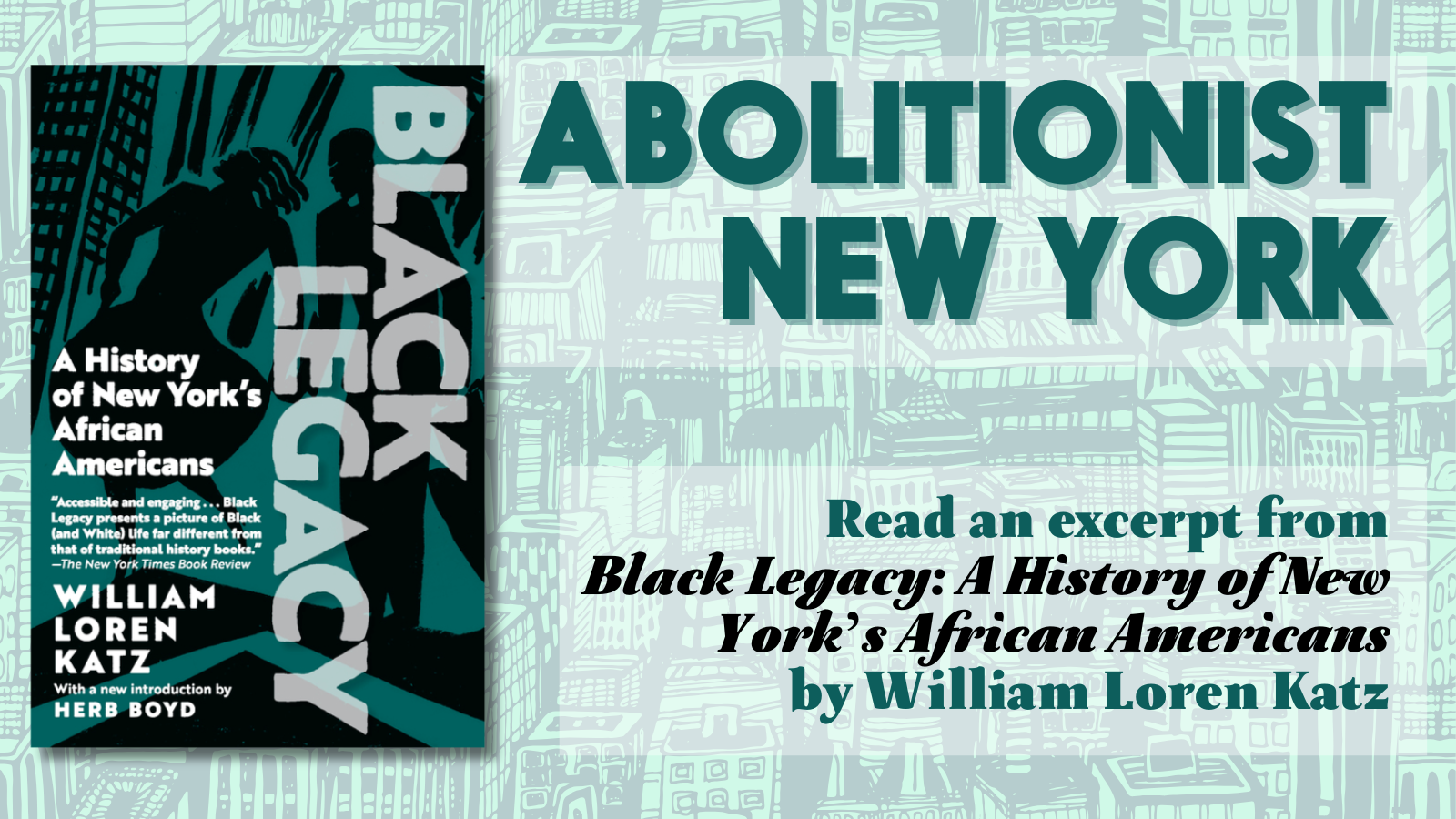
To celebrate the publication of Black Legacy by William Loren Katz, we're proud to share an excerpt of the book, a crucial history of Black New York, written for readers ages 12+, that begins with the 1609 arrival of the first enslaved Africans in New Amsterdam and takes us through the Civil War and Reconstruction, through the Harlem Renaissance, up through the present day. In this extract, Katz offers a history of Emancipation in New York, and some of the the ways in which the written word and other cultural outlets aided and shaped Black New Yorkers' struggle for freedom.
In 1817, the New York legislature voted a complete end to bondage—with all enslaved people to be freed by 1827. (The law did not affect citizens of other states, who could still bring enslaved people to New York for nine months at a time. When the state rescinded this nine-month rule in 1841, New York was free of people in bondage.)
After twenty-eight years of slow and painful progress, Emancipation Day dawned on July 4, 1827. Reverend William Hamilton welcomed the day with a special sermon at the African Zion Church. James McCune Smith, by then a leading civil rights activist, also spoke. Some ten thousand human beings in New York State had been freed.[4]
Emancipation dramatically altered the lives of Black people in the city. Free people could move and live where they wished. The 7,470 free people of color in the city in 1810 became 14,083 in 1830 but comprised only 2–3 percent of the city population because of massive white migration. More than thirty thousand other Black people resided outside the city.
Many Black men worked as sailors, particularly on whaling ships. At sea they could rise from a deckhand job to become a harpooner or first or second mate. By 1839, so many Black men worked on ships that they established their own seaman’s boardinghouse in New York.
But freedom did not mean equality, and the change increased acts of hatred from whites in the city. A French visitor reported being rudely treated because he had a friendly conversation with a Black woman employee of a rooming house. A barber admitted that if he cut the hair of fellow Black men, he would lose his white customers. In 1833, a French traveler reported that whites had denied people of color entrance to skilled trades. Black people found that emancipation failed to open doors to economic advancement.
Four months before emancipation, the first Black newspaper in the United States, Freedom’s Journal, was published in New York City. It appeared March 16, 1827, four years before William Lloyd Garrison issued his famous Liberator in Boston and six years before Garrison organized the American Anti-Slavery Society.
It would become the first organized voice of free people of color in the city and the nation. Its editors Samuel Cornish and John Russwurm were highly educated reformers. Russwurm, born into slavery, was an immigrant from Jamaica, and in 1826, when he graduated from Bowdoin College in Maine, he became one of the first Black college graduates. Cornish, born free in Delaware, had trained for the ministry and served as a missionary among Black New Yorkers.
Freedom’s Journal’s first editorial stated its goals:
We wish to plead our own cause. Too long have others spoken for us. Too long has the publick been deceived by misrepresentations, in things which concern us dearly . . .
Education being an object of the highest importance to the welfare of society, we shall endeavor to present just and adequate views of it, and to urge upon our brethren the necessity and expediency of training their children, while young, to habits of industry, and thus forming them for becoming useful members of society . . .
The civil rights of a people being of the greatest value, it shall ever be our duty to vindicate our brethren, when oppressed; and to lay the case before the publick. We shall also urge upon our brethren, (who are qualified by the laws of the different states) the expediency of using their elective franchise; and of making an independent use of the same . . .
Useful knowledge of every kind, and everything that relates to Africa, shall find a ready admission into our columns . . .
And . . . we would not be unmindful of our brethren who are in the iron fetters of bondage. They are our kindred by all the ties of nature . . .
Our vices and our degradation are ever arrayed against us, but our virtues are passed by unnoticed. [5]
In Freedom’s Journal, Samuel Cornish and John Russwurm called for an end to slavery and advocated equal rights for all. The Journal called for unity with white Americans who opposed slavery. The paper solidified New York’s Black intellectual class and attracted the attention of intellectuals from other cities. David Walker, who in two years would issue a fiery pamphlet calling for rebellions by enslaved people, wrote articles and became Freedom’s Journal's Boston agent. From Philadelphia, Bishop Richard Allen, a leader in the African Methodist Episcopal church, contributed articles to its pages.
The paper served as a platform for ideas that would be fully discussed in annual Black national conventions that began in 1830. During its first year, Freedom’s Journal published the earliest statement by an African American woman, “Matilda,” on women’s rights. Noting the paper had failed to advocate women’s education, she insisted that Black women “have minds that are capable and deserving of culture.” She wanted mothers to cram “their daughters’ minds with useful learning” and to see that they read books. Matilda continued:
There are difficulties, and great difficulties in the way of our advancement; but that should only stir us to greater efforts . . . Ignorant ourselves, how can we be expected to form the minds of our youth, and conduct them in the paths of knowledge? There is a great responsibility resting some-where, and it is time for us to be up and doing. [6]
The two editors soon took divergent paths in their drives to liberate their people. In Freedom’s Journal, Russwurm announced that African Americans should return to the African homeland. In 1829, he left for Liberia, an African nation founded by former US slaves, where he became an educator and a public official. Cornish edited the successor of Freedom’s Journal, The Rights of All, and then another New York paper, The Colored American. In 1833, he was a founding member of the New York Anti-Slavery Society and remained a potent city voice for antislavery and equal rights.
By 1863, the path pioneered by Freedom’s Journal had been taken up by twelve other Black papers in New York State, including eight in the city.
. . .
Solomon Northup of New York also made an unusual contribution to the antislavery struggle. In 1829, he was seized from a street in Washington, DC, while visiting there and enslaved in Louisiana. He could not escape until 1841, but safely back home in New York he wrote a book of his life in bondage that became a weapon in the antislavery arsenal. His Narrative of Solomon Northup was one of more than a hundred autobiographies by formerly enslaved people that exposed the system’s evils to white readers.
As they waged war against slavery, Black New Yorkers did not neglect their own struggle for equality. In the 1830s, few Black Americans could vote because of the property qualifications imposed on them. But those who did vote were still able to affect city politics. They defeated the Democrats in the Fifth Ward, and helped Federalists gain three seats in the neighboring Eighth Ward. In 1844, one Democrat warned of Black people: “Their number in the city of New York was very great, and parties were so evenly divided that it was often sufficient to hold the balance between them.”
In New York and other Northern states, “Black Laws” did more than deny people of color voting rights. Black citizens could not legally hold office, serve on juries or in the militia, or give testimony against white people in court. To fight slavery and win full citizenship privileges, beginning in 1830 Black people in the North began to hold annual national conventions, some in New York. Delegates discussed how to fight the Black Laws and how to reach political and economic equality.
The convention movement debated and gave voice to Black opposition to slavery and discrimination. It also served as a forum that unified an educated and growing intellectual and leadership class. In 1843, Reverend Henry Highland Garnet of Troy—at twenty-seven, recently ordained a Presbyterian minister and just married to Julia Williams—made his own unique contribution to the anti-slavery crusade. That year at a national Black convention in Buffalo, he called for massive rebellions of enslaved people, shouting, “resistance, resistance, RESISTANCE!”
Offered to delegates as a resolution and opposed by Frederick Douglass, Garnet’s call failed to carry by a single vote. But Garnet’s militant approach increasingly won acceptance among abolitionists. In 1848, John Brown reprinted Gar-net’s call for rebellions in a pamphlet that included David Walker’s fiery Appeal. By the next year Frederick Douglass announced he would be pleased to hear the news “that the slaves had risen in the South.” [8]
Drawing support from the convention movement, churches, and newspapers, Black New Yorkers sought to build better lives. By the 1840s, Black businesspeople operated two fashionable restaurants in the financial district, two dry goods stores, a hairdressing shop, three tailor stores, a candy store, a fruit store, and two coal yards.
However, most people of color were held to the lowest jobs. Abolitionist Gerrit Smith described discrimination in the state:
Even the noblest black is denied that which is free to the vilest white. The omnibus, the car, the ballot-box, the jury box, the halls of legislation, the army, the public lands, the school, the church, the lecture room, the social circle, the table, are all either absolutely or virtually denied to him.
Though slavery ended in the state, discrimination was an ever-present factor in Black lives. Religious services, once open to all, became segregated as white churches instituted “Negro pews” to separate people of color. Some Black parishioners called for direct action. In 1837, the Colored American urged its readers: “Stand in the aisles, and rather worship God upon your feet, than become a party to your own degradation. You must shame your oppressors, and wear out prejudice by this holy policy.” In 1845, the city boasted fifteen African American Methodist churches. Black teachers felt the need to organize, and in 1841, sixteen of them in the city formed an association, issued their own Journal of Education, and organized a convention on Long Island to petition for equal voting rights. The teachers, summoning others from Brooklyn and Queens, issued this call:
Hundreds of children that are now shut out from the blessings of Education, call loudly up to you to come. If there ever was a time that called for united action, it is now. If there ever was a time for colored freemen to show their love of liberty, their hatred of ignorance, and determination to be free and enlightened, it is now. We want union and action.
The Black effort to end voting restrictions at first moved few white citizens. Finally, in 1846, it won support from Horace Greeley’s New York Tribune. Greeley published a Black call for equal voting rights and listed it as the first among needed city reforms. But most white citizens remained opposed to equal suffrage.
Along northern boundaries of Manhattan, the community of Harlem had begun to grow. Many of the poor residents were Irish, but by 1832 Black New Yorkers had settled around the area of the Harlem Methodist Church. In 1843, members of the African Methodist Episcopal Zion Church had a new brick building on East 117th Street for its sixty-six members. Later that decade Harlem’s Bethel A.M.E. Church was started, and by the 1850s a public school had been built.
NEW YORK CITY’S BLACK POPULATION [9]
1830 — 14,083
1840 — 16,358
1850 — 13,815
1860 — 12,574