Translated by Zenia H. Tompkins
Named a Best Book of 2024 by The Telegraph (UK)
A stunning debut collection of fiction and creative nonfiction— irreverent and unglorified; loving and tender; uncomfortable and inconvenient—by a Ukrainian writer currently fighting for his country in Kyiv.
Includes the celebrated title story "The Ukraine," which was published in the New Yorker in 2022.
The Ukraine is a collection of 26 pieces that deliberately blur the line between nonfiction and fiction, conjuring the essence of a beloved country through its tastes, smells, and sounds, its small towns and big cities, its people and their compassion and indifference, simplicities and complications.
- In the title story, Chapeye facetiously plays with the English misuse of the article “the” in reference to Ukraine, capturing a country as perceived from the outside, by foreigners. That pseudo-kitsch, often historically shallow, and not-quite-real Ukraine resonates because of its highly engaging and brutally candid snapshots of ordinary lives and typical places.
- In “One Soul per Home” an elderly woman laments that the men are dying and the young are leaving for the cities, changing the face of her small town;
- In “The Unscrupulous Spirit of the Provinces,” a couple of unspecified gender get stoned and go to church; and in “False Premises,” a man romanticizes his younger years working for a Soviet fishing fleet only to reconstruct his nostalgia in the face of Putin’s Russia.
The Ukraine conveys to readers a place that Chapeye and his countrymen are currently fighting for with their lives. The book features a preface by the author, which he composed on his phone from the front lines.
Seven Questions with Artem Chapeye
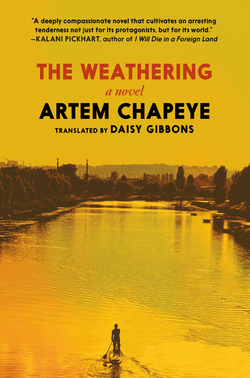
In April, we were pleased to publish our third book by Artem Chapeye, an award-winning author from Ukraine. The Weathering, translated by Daisy Gibbons, follows a young couple from Kyiv who take a trip to the Carpathian Mountains to escape their digital creative lives. Upon their return, they discover that the world as they once knew it no longer exists. But the book is about so much more than apocalyptic ruin—in The Weathering, Artem examines complacency and self-betrayal, propaganda apparatuses, ecological restoration, and what it fundamentally means to be humane.
In our conversation, Artem discussed his desire to be read not as a “Ukrainian writer” but as a writer of world literature, and the universal themes he hopes readers take away from the book.
I’d love to know what inspired you to write The Weathering. I’m particularly interested in your desire to write a dystopia, which is different from the style of your two previous books with Seven Stories, The Ukraine and Ordinary People Don’t Carry Machine Guns, both of which are creative nonfiction. What did writing a dystopia allow you to do creatively?
I can’t say The Weathering is your classical dystopia, for largely it is also a parody. There’s a lot of irony and subtle sarcasm. The story germinated for about seven years. I started writing The Weathering back in 2014 after Russia first invaded Ukraine, having occupied and annexed Crimea and parts of Eastern Ukraine. Russian imperialism first acted via so-called “people’s republics.” Most of them failed, but two “succeeded” because Russian troops supported these Russian-created puppets, often comprised of just a dozen people promoting the disturbances.
We Ukrainians joked a lot, bitterly, about such artificial separatism, going to the absurd. For U.S. readers, imagine Wall Street proclaiming a separate “Manhattan People’s Republic” with slogans like “Let’s stop feeding Brooklyn!” That’s how ridiculous it all seemed. Ridiculous, yet dangerous.
This is how the idea for a separate “Rusanivka Island Republic” first emerged. Rusanivka is my neighborhood within Kyiv. I postponed developing the idea until it “ripened” in my head. During the COVID lockdowns it clicked. We sometimes had the sarcastic feeling that “Finally, this is it, the end of the world.” The pandemic gave me a more global perspective and also made the metaphors more multi-faceted.
That’s when I wrote most of the book, during the lockdowns of 2020 and 2021, having picked up on the previous idea of “Rusanivka Republic” and combining it with the COVID themes, both serious and also ridiculous, like “Nature has cleansed itself so much and so fast that dolphins now live in the Venice bay”, if you remember that one.
The topics of nature vs human, and of environmentalism are huge in The Weathering, too.
You write in your author’s note that you try to focus on universality and dispel the different standards that Western vs. Eastern writers are held to. A German writer, you say, is speaking “on behalf of all humanity” but a Ukrainian writer is just considered an “ethnic writer.” Do you feel like you’ve been put into a box as a “Ukrainian” writer? And can you tell me more about this desire to write universally?
For the “German writer”, this is a reference from Orhan Pamuk’s great novel Snow, and it’s something said there by a Kurdish poet. The problem is a general one: only a few countries are expected to create “world literature,” and predominantly these are the so called “core countries” of sociology, mostly empires or ex-empires. Most of humanity are considered “periphery,” and their art is expected to deal with “ethnic color” rather than “human condition.”
Only a few countries are expected to create “world literature,” and predominantly these are the so called “core countries” of sociology, mostly empires or ex-empires. Most of humanity are considered “periphery,” and their art is expected to deal with “ethnic color” rather than “human condition.”
Ukraine is only one in over a hundred such countries. Take the great Albanian writer Ismail Kadare, for example. Should he have written in, say, Russian, his work would be recognized as “great literature” like, say, Tolstoy, and would be read everywhere by millions. However, as Kadare wrote in Albanian, only connoisseurs read him in translation.
Of course, I want to be a representative of world literature while being a Ukrainian author. This would not even be a question for a British, French, Russian, or American author but it’s always something not taken for granted by any author from Albania (Ismail Kadare), Kenya (Ngũgĩ wa Thiong’o), or Ukraine (Michael Kotsiubinsky).
That theme of universality came through in your observations about the narratives we create about each other. Whether about those we are closest to, like the narrator and his wife, or about those we don’t know at all, like the opposing “Truhans,” or meant to spread propaganda or be used as coping mechanisms, these narratives are told in order to make sense of a nonsensical world. What made you interested in exploring these themes in this book? Were there any real-world instances you drew inspiration from?
We all share the same humanity and yet are often little known to each other. The protagonist often thinks that even though, according to John Donne, “No man is an island,” in the other hand, each person is an island in themselves, and that he, the unnamed protagonist only knows the “shore”, or the outer layers even of his closest person, Zoia.
With others or people farther away, achieving the proximity is even more difficult. Besides, propaganda often creates an enemy where one could instead have cooperated. If a reader reads The Weathering attentively, he or she may notice numerous references to migrant-phobia, refugee-phobia, Islamophobia, and echoes of wars such as in Syria and several “refugee crises” in Europe, things that were happening as the book was being written.
While the book is narratively about the “weathering away” of humankind, it’s really about the loss of humanity. For example, you often describe the characters in this book as “beasts.” What do you want readers to take away from this message? Is it a warning?
The “animal” vs “beast” inside each “human” being is a metaphor my grandpa once used when I was six or seven years old and it is described in detail in The Weathering. This is something one notices in many societies, especially during hard times. Some people tend to lose a part of their humanity, humaneness. The hard times doesn’t have to be war. Consider the hate directed towards immigrants during the political campaigns in the U.S., for example. We have discussed how this is fed by the insufficient knowledge of the people who are seen as “unlike us.”
You started writing The Weathering in 2014 when Russia illegally annexed Crimea and finished it in 2021 during the COVID-19 pandemic. How did the story develop over these years? And do you think about it differently today, knowing all that has happened with the full-scale Russian invasion and the ongoing wars in the Middle East?
As I discussed at the beginning of the interview, the story added layers as it developed. The pandemic added universality, for we all seemed in the same boat at the time. People were dying in NYC just as in any sub-Saharan African city.
Knowing what had since happened in Ukraine, in Gaza, and is now happening all over the Middle East, and the seeming gradual weathering away of democracy in the U.S. which can still be stopped, just shows once again how the effort not to “weather away” in our humanity is needed at all times and in all parts of the planet.
We haven’t yet mentioned it, but this also has become more important since I finished the book: The Weathering also describes a gradual strengthening of authoritarian tendencies, and this is something which makes the book more and more relevant in some former “liberal democratic” countries. The authoritarian tendencies are not about “the periphery” anymore.
Without spoiling too much, the book’s ending toes the line between hopeful and pessimistic. Do you feel hopeful? Or, perhaps, do you as a writer feel a duty to be hopeful?
I feel like the book has an open ending, well, on the hopeful side. We in Ukraine have twice brought down authoritarianism at home, in 2004 and in 2013, and are since repelling a huge imperialist assault. The price is high, but what we have is better than succumbing and giving in. We are not the only ones.
The COVID pandemic did end, thanks to global efforts. As we’re speaking, my neighboring Hungary seems to be coming back, after 16 years of gradual “weathering away” of its democracy. Other countries have the chance to rebound as well. Same as our protagonists in The Weathering try, “even after the end of the world”, as Zoia jokes.
So, yeah, humanity is more resistant to “weathering away” than one could expect, and this is why I feel cautiously optimistic.
Are there any books in the Seven Stories backlist that you were thinking of while writing The Weathering? Or, are there any writers whose work you drew from throughout the writing process?
Of the books Seven Stories published, I loved most Liliana Corobca’s Too Great a Sky! I loved the atmosphere. I also loved Octavia Butler’s Parable of the Sower, but I wrote The Weathering back in 2014-2021, so before I read Seven Stories books.
As for writers I was inspired by when writing The Weathering, I mostly think of Kawabata Yasunari, even though he never wrote speculative fiction. One of the characters in my book even jokes about “tender Japanese-style stuff.”
An author of both creative nonfiction and popular fiction, ARTEM CHAPEYE was born and raised in the small Western Ukrainian city of Kolomyia and has spent much of the last twenty years living in Kyiv. He is the author of two novels and four books of creative nonfiction in Ukrainian, is a co-author of a book of war reportage, and has four-times been a finalist of the BBC Book of the Year Award. The title story of his recent collection The Ukraine (Seven Stories Press; January 2024) was excerpted in The New Yorker and received high praise. Artem is an avid traveler who spent close to two years living, working, and traveling in the U.S. and Central America—an experience that has greatly informed his writing. His work has been translated into seven languages and has appeared in English in the Best European Fiction anthology and in publications such as Refugees Worldwide, translated by Marian Schwartz. Artem is a past recipient of the Central European Initiative Fellowship for Writers in Residence (Slovenia) and the Paul Celan Fellowship for Translators (Austria), as well as a finalist of the Kurt Schork Award in International Journalism. He serves on the board of PEN Ukraine. He has been a soldier in the Ukrainian army since the early days of the full-scale Russian invasion.
Award-winning Ukranian author Artem Chapeye’s new novel follows two struggling freelancers who return from a country vacation to find their home city of Kyiv transformed into an apocalyptic dystopia.
As they contend with the aftermath of an earth-shattering event that they didn’t witness, the couple is must align themselves with the rest of the survivors to retain their humanity and forge a new world in the ashes of the old. As award-winning author Kalani Pickhart (I Will Die in a Foreign Land) says, The Weathering is “[a]n empathetic, emotionally raw account that is as darkly humorous as it is horrific, [and] balances the universality of humankind’s survival in a post-apocalyptic world through a uniquely Ukrainian perspective.”
Will the couple be able to survive, make alliances with others, and give birth to a new generation? Will the insidiousness of human nature manifest itself in this new, post-apocalyptic world? Filled with beautifully melancholic and black humor, The Weathering becomes a kind of study of behavior in critical situations when everything that once seemed stable falls apart.
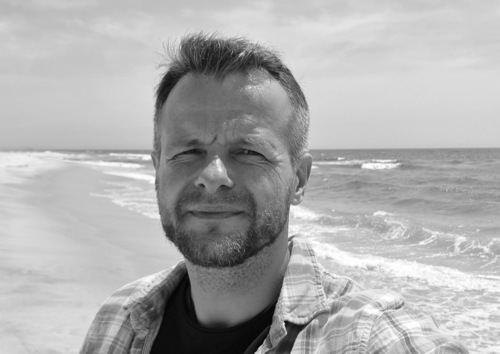
An author of both creative nonfiction and popular fiction, ARTEM CHAPEYE was born and raised in the small Western Ukrainian city of Kolomyia and has spent much of the last twenty years living in Kyiv. He is the author of two novels and four books of creative nonfiction in Ukrainian, is a co-author of a book of war reportage, and has four-times been a finalist of the BBC Book of the Year Award. The title story of his recent collection The Ukraine (Seven Stories Press; January 2024) was excerpted in The New Yorker and received high praise. Artem is an avid traveler who spent close to two years living, working, and traveling in the U.S. and Central America—an experience that has greatly informed his writing. His work has been translated into seven languages and has appeared in English in the Best European Fiction anthology and in publications such as Refugees Worldwide, translated by Marian Schwartz. Artem is a past recipient of the Central European Initiative Fellowship for Writers in Residence (Slovenia) and the Paul Celan Fellowship for Translators (Austria), as well as a finalist of the Kurt Schork Award in International Journalism. He serves on the board of PEN Ukraine. He has been a soldier in the Ukrainian army since the early days of the full-scale Russian invasion.

ZENIA H. TOMPKINS is an American literary translator and founder of The Tompkins Agency for Ukrainian Literature in Translation (TAULT, tault.org). Her published books include adult fiction, adult nonfiction,and children’s. Zenia’s work as a translator and promoter of Ukrainian literature has been featured by the New York Times, The New Yorker, Poets & Writers Magazine, BBC Radio, National Public Radio, and Public Radio International. She will be devoting 2023 and 2024 to working exclusively with Ukrainian authors who have enlisted in Ukraine’s armed forces since the Russian invasion. Since its inception in 2019, TAULT has worked with over one hundred of Ukraine’s top and emerging authors.