In a near-future New York City in which both global warming and a tremendous economic divide are making the city unlivable for many, a huge superstorm hits, leaving behind only those who had nowhere else to go and no way to get out.
Makayla is a twenty-four-year-old woman who works at the convenience store chain that’s taken over the city. Jesse, an eighteen-year-old, genderqueer, anarchist punk lives in an abandoned IRT station in the Bronx. Their paths cross in the aftermath of the storm when they, along with others devastated by the loss of their homes, carve out a small sanctuary in an abandoned luxury condo. In an attempt to bring hope to those who feel forsaken, an unnamed, mysterious street artist begins graffitiing colorful murals along the sides of buildings. But the castaways of the storm aren’t the only ones who find beauty in the art. When the media begins broadcasting the emergence of the murals and one appears on the building Makayla, Jesse, and their friends are living in, it is only a matter of time before those who own the building come back to claim what is theirs. Alex DiFrancesco's All City is more than a novel, it’s a foreshadowing of the world to come.
Seven Questions with Alex DiFrancesco
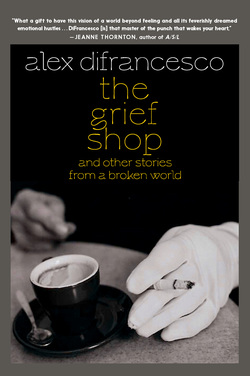
We're pleased to share a short interview with Seven Stories author Alex DiFrancesco, whose newest book asks, how do you tell the story of being human in an unfeeling world? A linked collection of speculative short fiction, The Grief Shop follows Gemma, a woman navigating surreal jobs in a near-future dystopia, wherein a cataclysmic event has rendered the population unable to feel emotions "organically."
Gemma must wrestle with the void of indifference. At her many jobs—a grief-infused coffee shop, a boxing gym for pain therapy, a graveyard, etc.—she encounters a range of eccentrics struggling to survive in a world where grief, ecstasy, suffering, and joy are commodities for some to purchase and for others to exploit. Gemma’s path is one of glimmering possibilities, ones with feelings she may not understand or accept.
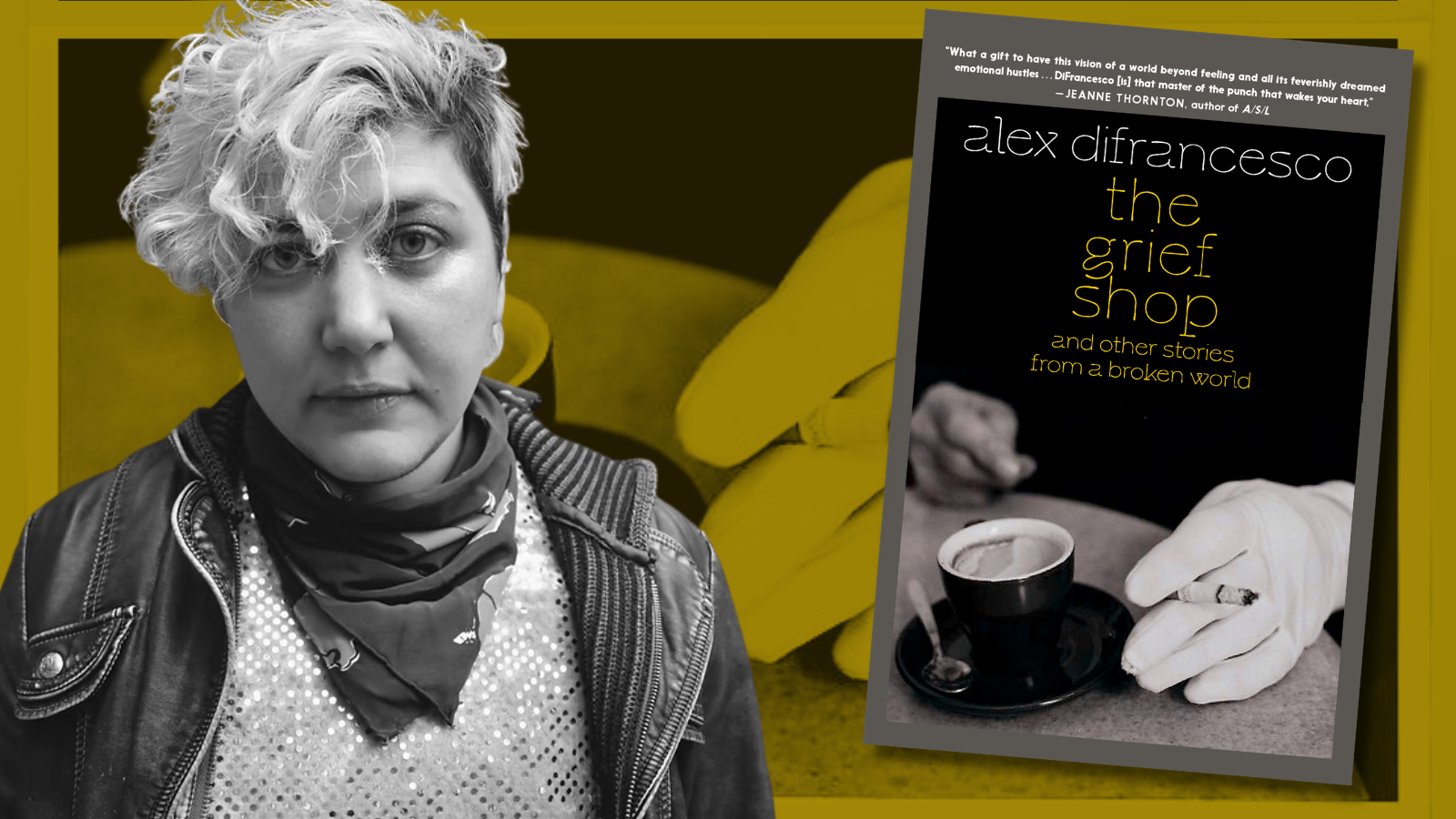
Along with The Grief Shop, Alex DiFrancesco is the author of the dystopian novel All City, the story collection Transmutation, and the memoir Breaking the Curse. They are the winner of an Ohio Arts Council Individual Excellence Award for 2022, and their novel All City was the first awards finalist by a transgender author for the Ohioana Book Awards in its eighty-year history. They served as an assistant editor for Sundress Publications in Tennessee, and edited LGBTQIA+ non-fiction for Jessica Kingsley Publishers. Their work has appeared in Tin House, Electric Literature, Pacific Standard, Eater, and Vol. 1 Brooklyn, among others. DiFrancesco lives in Philadelphia.
The stories in The Grief Shop take place in the wake of a global tragedy, which only accelerated an all-consuming nihilism that your characters then grapple with. This is a world that feels both vaguely removed and, in many ways, innately parallel to our own. I’m wondering how you see The Grief Shop in regards to its elements of realism versus its more dystopian aspects? Did you struggle with how and when to balance familiarity with discombobulation?
I started writing The Grief Shop in 2022, shortly after the COVID-19 lockdown. I wanted to make it a direct reaction to that tragedy, but as I kept writing, tragedies kept accumulating in the world around me. Rising fascism. The genocide in Palestine. The war in Ukraine. The climate. Eventually, it became clear that "the tragedy" had to be a blank in the book because it was important for me for readers to be able to plug in their biggest tragedy from all the many, many choices. Like any of my dystopian work, this novel is firmly based in reality, with just a little "what if-ing" and peeking down the corridor of what could possibly come. I use my imagination from the platform of the elements of reality that are most inspiring.
Your previous novels, Transmutation and All City, heavily featured both transgender and gender-queer characters. In contrast, transness isn’t an explicit focal point in The Grief Shop. Did this change how you approached writing The Grief Shop and its characters? Are there ways that you interpret The Grief Shop as a queer or queer-adjacent narrative?
The main character, Gemma, is a queer character, though it's not really a focal point of the book. When I was writing All City (which I started writing 13 years ago), there was a dearth of trans and genderqueer characters in literature, and it was important for me to portray them in climate change fiction. That novel also has a sort of "guns blazing" approach to queerness and radical politics. I think my need to be so explicit about such things is still there, just in a different form.
In the story “The Bad Neo-Dadaist,” we’re introduced to a group of artists who solely create nonsensical art pieces using modern culture. Xander, a recurring character throughout The Grief Shop, refers to the content of their art as “Replications, AI shit, nonsensical memes…” Can you say a little bit about how you came up with the idea for the Neo-Dadaists? What role do you see them playing alongside your other characters?
The original Dadaist movement was a reaction to World War I and its atrocities. Dadaism was pretty nonsensical, though firmly based in leftist politics and anti-war sentiments. So, the inspiration for the "Neo-Dadaists" in the book (I put this in quotes because there was an actual Neo-Dadaist movement in the '50s and '60s) was all the nonsense and none of the politics, or hope for a better future, or sincere lampooning of capitalism, or anything that mattered. Just nonsense devoid of meaning. In this world where meaning is something some people, like Gemma, are searching for, the Neo-Dadaists are rejecting it entirely. Except, of course, the Neo-Dadaist Ezra, who finds meaning in everything.
Despite the pervasive numbness Gemma experiences, she’s still beholden to the basic biological necessities of her body. At the end of “Tragedy’s Prophet,” Gemma has a muted emotional reaction to the death of her mother, and instead only feels a “a little gnawing hunger starting to grow in my body” which, she notes, is her sign to go and make dinner. It feels to me like The Grief Shop is partially an exploration into what happens when our mental processes become severed from our physical ones. Was this something you set out to explore when writing the book? What do you feel is important about Gemma’s, and the other The Grief Shop characters, physical and mental divide?
Yes, this was something I consciously set out to explore. At one point in the book, some characters are wondering what they have left to motivate them — morals, ethics, biological drives? And Xander notes that eating and fucking are things that people will always want to do, even if life seems meaningless.
Connie Converse plays a large role in the ending of The Grief Shop; did you originally plan to include Converse in the book when you began writing? What impact has she, and her music, had on your own life?
Connie Converse is a folk musician who's probably best known for vanishing without a trace. I've always loved her music and her legend, but there was something more that motivated me to include her. It has to do with hero-worship of artists, who are, at the end of the day, just humans who happen to make good art. I think this line of thought arose for me because I spend a lot of time reading Nick Cave's Red Hand Files newsletter, where he responds to fan questions. Sometimes his answers are beautiful, and sometimes they're just atrocious, and it really made me think a lot about what an "art hero" is. So Connie Converse, in the book, is Ezra's art hero, and one who can really do no wrong since she ejected herself from the public eye long ago and had been missing ever since. But what Ezra discovers is similar to what I discovered from reading Nick Cave's newsletter — artists are just kinda average people, with opinions and thoughts you may or may not agree with, not people to put on a pedestal and idolize. They can't save us. They're not built to be heroes. They're just people who happen to make art. And you can find whatever meaning you need to in them and their work, but the fact remains that they're just people who make art, not anyone who can save us.
Are there any books in the Seven Stories backlist that you were thinking of while writing The Grief Shop? Or are there any writers whose work you drew from throughout the writing process?
Some of my favorite SSP backlist books are Chavisa Woods's Things to Do When You're Goth in the Country, Luis Negron's Mundo Cruel, and Youseff Rakah's The Crocodiles. I don't know that they were a direct inspiration for this book, but they're books that have stayed with me since I first read them, and which I come back to in my mind often, so I suppose they probably affect my aesthetics, if nothing else!
Do you have any thoughts or hopes for how readers, whether old or new, might respond to the book?
I'm always hoping that at least one feral weirdo will see themselves in my work and realize there is a place for their work out there, too.
From the author of Transmutation comes a linked collection of speculative short fiction that follows a woman navigating surreal jobs in a near-future dystopia, in which people have become completely numb to their emotions following a cataclysmic event.
How do you tell the story of being human in an unfeeling world?
After an unnamed tragedy renders humanity numb, Gemma must wrestle with the void of indifference. She works a series of jobs—at a grief-infused coffee shop, a boxing gym for pain therapy, a graveyard, and more—and encounters a range of eccentric characters struggling to survive in a world where grief, ecstasy, suffering, and joy are commodities for some to purchase and for others to exploit. Gemma’s path is one of glimmering possibilities, ones with feelings she may not understand or accept.
The Grief Shop is a remarkable meditation on what it is to be—even when the very characteristics that make us human have been stripped away.
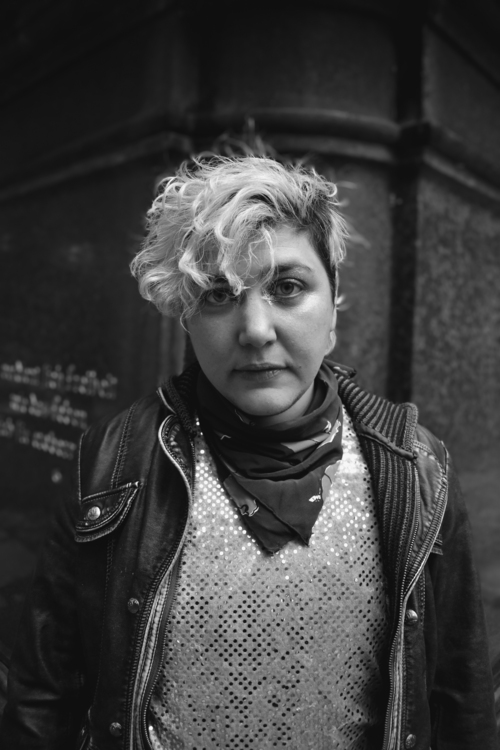
ALEX DIFRANCESCO is the author of the dystopian novel All City, the story collection reflecting trans realities Transmutation, and the memoir Breaking the Curse (2024). About their debut story collection, Patrick Cottrell wrote in The New York Times: “At the affective core of Transmutation is the question of how we can offer shelter for one another’s pain, real and imagined.” They are the winner of an Ohio Arts Council Individual Excellence Award for 2022, and their novel All City was the first awards finalist by a transgender author for the Ohioana Book Awards in its eighty-year history. They served as an assistant editor for Sundress Publications in Tennessee, and edited LGBTQIA+ non-fiction for Jessica Kingsley Publishers. Their work has appeared in Tin House, Electric Literature, Pacific Standard, Eater, and Vol. 1 Brooklyn, among others. DiFrancesco lives in Philadelphia.