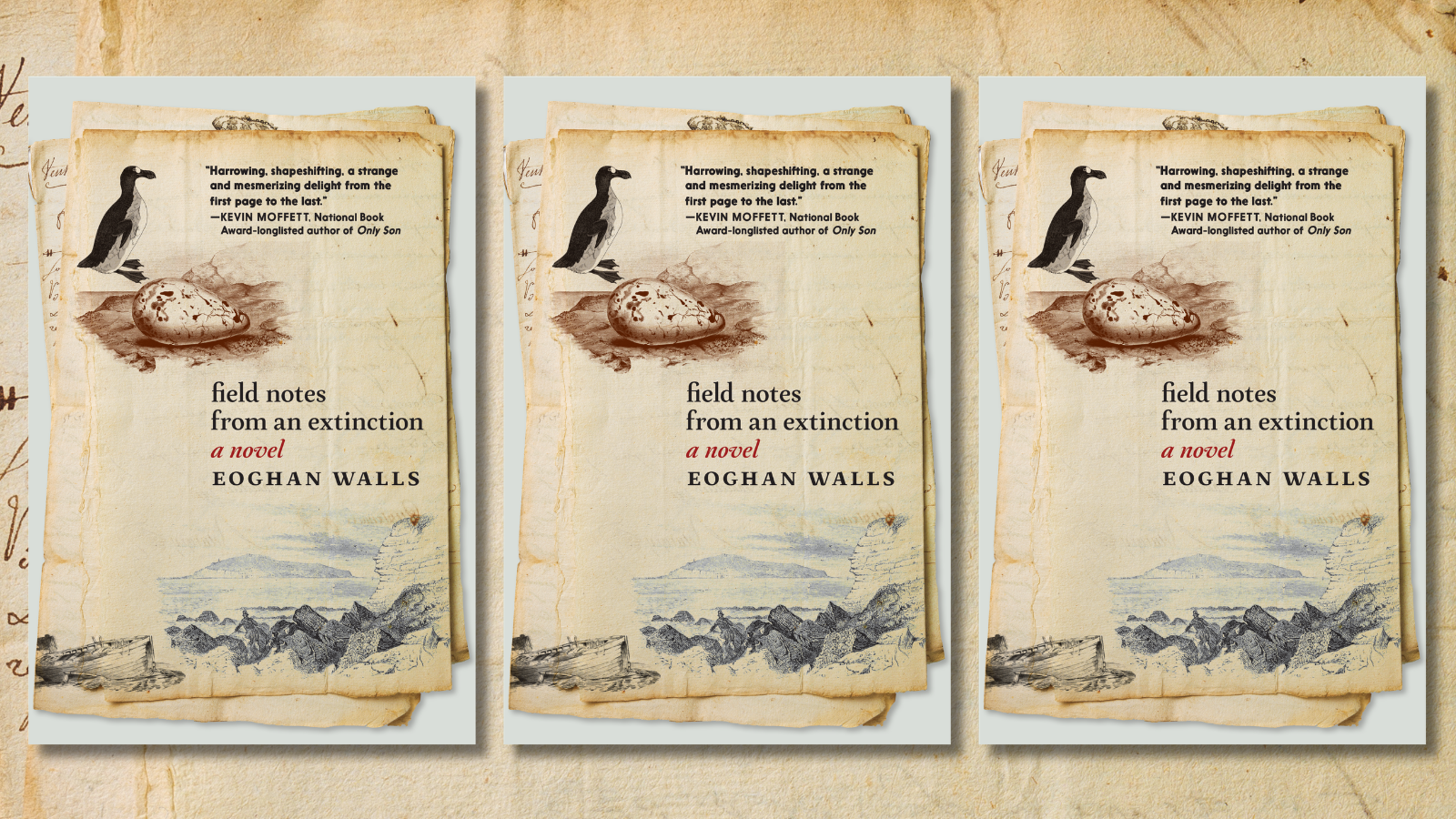
Jessica Sequeira’s translator’s note for “The Eighth Wonder” by Vlady Kociancich
Vlady Kociancich’s The Eighth Wonder, the first of her works to be translated into English in over 30 years, follows Alberto Paradella, a lawyer slash travel journalist slash fledgling translator in his early 30s who, in a fit of self-doubt and self-delusion, tells everyone he knows the very charming and relatable lie that he is writing a book. Set in the 1970s during the Argentine Dirty War, Paradella soon leaves Argentina, drifting across Europe and falling deeper into the schism between reality, memory, and fantasy.
In her compelling Translator’s Note, which you can read below in full, translator Jessica Sequeira breaks down the complexities, idiosyncrasies, and the joys of translating Kociancich’s novel, and rendering into English the many colloquialisms and layered references found in the work. And, of course, the inescapable presence of Joseph Conrad.
Double Itinerary
Along with her novels, Vlady Kociancich worked on a translation of Joseph Conrad’s The End of the Tether, which according to her obituary by Daniel Gigena in La Nación, “había sido muy elogiada” (was highly praised). This translation is present in The Eighth Wonder, explicitly given that the narrator is working on a translation of this book, as well as in more hidden forms.
Alberto Paradella, the lawyer-turned-writer-turned-translator-turned-journalist-turned-scriptwriter at one point refers to the journey between the Spanish and English versions of the text he is working on as a “double itinerary”; the metaphor of the journey as a bidirectional translation, where the very process of moving alters the elements in movement, carries through the book in many ways. In the novel, Paradella cannot seem to finish the translation, due to distractions, heartbreaks, travels, and misplacements of the manuscript. In “real life,” Kociancich did finish the translation, which she worked on at the same time as she wrote The Eighth Wonder, and which was published as Con la soga al cuello by Emecé in an edition with a noose on the cover, later reprinted in an edition by Hyspamérica together with Sergio Pitol’s translation of El corazón de las tinieblas (Heart of Darkness) and a prologue by Jorge Luis Borges.
There are multiple Spanish translations of The End of the Tether—En las últimas, Situación límite, El cabo de la cuerda—but Kociancich’s title Con la soga al cuello, which can be more literally translated as With the Rope Around the Neck, is my favorite. It slightly shifts Conrad’s title, just as Borges’ title Otra vuelta de tuerca (Another Turn of the Screw) gave a further swivel to the novella by Henry James.
Which makes me think: maybe Paradella did finish his translation. The entirety of The Eighth Wonder could be read as Kociancich’s translation of Conrad’s The End of the Tether taken to its extreme, where the translator has entered so deeply into the book that what she translates are not just words, phrases, and ideas, but scenes and atmospheres, so that the book journeys from the colonial world of Singapore to the contemporary world of Buenos Aires. This is something different from “rewriting,” The dizzying movements in The End of the Tether across land and sea, from the English boardinghouse to the Malaysian coastline, with stops at temporary ports and the only home one’s boat, are mirrored in the Argentine travel journalist’s movements from Villa del Parque to the Berlin metropolis, passing through airports with only books and dreams as one’s home. Transition and movement become the only constant, until it becomes impossible to return or even locate home.
An endless journey, a trip one cannot escape, which might be a synonym for nightmare. Or as Conrad puts it: “Captain Whalley, substantial and dignified, left well-nigh alone in the vast hotel by each light-hearted skurry, felt more and more like a stranded tourist with no aim in view, like a forlorn traveler without a home.” From Conrad’s The End of the Tether to Kociancich’s La soga al cuello to Kociancich’s La octava maravilla to this translation The Eighth Wonder—this too has been a journey, one of many possible.
In an interview with Silvina Friera for Página/12, Kociancich said:
Quería incorporar la idea de que todos vivimos traduciendo la realidad, traduciendo a las otras personas, aunque nunca vas a conocer a alguien enteramente. Traduje una de las más hermosas novelas de Joseph Conrad, La soga al cuello, hice xtoda esa experiencia porque no estaba escribiendo ficción. Al traducir a Conrad, a quien venero, me di cuenta de que tenía que conseguir el tono de la prosa de Conrad. Lo que me quedó fue la experiencia de que realmente estaba traduciendo, dando una versión, porque, lo mismo en la vida, hay sentimientos que son intraducibles.
(I wanted to incorporate the idea that all of us live translating reality, translating other people, even if it’s never possible to know somebody completely. I translated one of the most beautiful novels by Joseph Conrad, The End of the Tether, I went through that whole experience because I wasn’t writing fiction. While translating Conrad, whom I venerate, I realized that I had to achieve the tone of Conrad’s prose. What stays with me from that experience is that I was translating in the full sense, giving my own version, because just as in life, there are sentiments that are untranslatable.)
“The Eighth Wonder is both things [cinema and journey], because the cinema is a journey, and the journey is the substance of cinema. The two occupy time and space, but outside of the moment in which they exist, they have no reality at all.”
—Vlady Kociancich, The Eighth Wonder
“Whalley could in a half hour of solitude live again all his life, with its romance, its idyl, and its sorrow.”
—Joseph Conrad, The End of the Tether
The Great Pyramid of Giza, the Colossus of Rhodes, the Hanging Gardens of Babylon, the Lighthouse of Alexandria, the Mausoleum at Halicarnassus, the Statue of Zeus at Olympia, the Temple of Artemis at Ephesus: these were Herodotus’ seven ancient wonders. The eighth wonder, in this novel, is simultaneously the journey and the cinema. Both are all-absorbing; both are forms of movement that transform one’s mind. The seventh art of the cinema, and the seven wonders of the world: these are perhaps like the seventh note in a musical scale, the point of maximum tension before the eighth begins a new scale.
I think of the Spanish phrase “me paso la película” (I see it as if it were a film), which evokes the moment that one sees everything flash through one’s mind, as if it already happened. There is a pleasure in this capacity for fantasy, for viewing everything at once. Something like the complement to the bardo after death, but projected into the future, where one observes what is to come and develops the seed of the present into a satisfying narrative arc, with all its happiness or tragedy, its “risas y penas” (laughs and griefs), as the salsa singer Héctor Lavoe put it. The phrase cradles this paradox; depending on the context, the phrase could mean bliss or tragedy. “Me paso la película” could be used in almost any context, from the romantic (say, a fantasy about a person one desires) to the terrifying (say, fear of an accident). The capacity to envision bears everything.
Here we can move to an actual film. The brief 1978 documentary Borges para millones begins with the process itself of shooting, attentive to its own creation. Then it abruptly cuts to Borges, seated in a chair, with waxen-looking skin and carved features, in Technicolor. He speaks fast, like an automaton, without pauses, as if he’d spoken the same lines a million times before, opining that typical Argentines are from everywhere, “fácilmente cosmopolitos” (easily cosmopolitan), and should thus read all the books, live all the experiences, “no negarnos a nada” (deny ourselves nothing). He is currently learning Icelandic, he says. The documentary speaks of Borges as an incessant traveler, a mythical public figure; it speaks of his childhood memories with their endless mirrors, of his books of poetry, and of how one is constantly working at literature via the imagination. Images of the streets of Buenos Aires appear in faded yellow, including an inner patio with a palm tree.
Borges wasn’t just a poet shut away isolated in his library, the documentary argues, even if he spent infinite hours poring over Rafael Cansinos-Asséns’s translation of The Thousand and One Nights, the writings of Macedonio Fernández, and so many other works, along with writing for the magazine Sur and working at the Biblioteca Nacional. The death of his father hit him hard; the rain in “La lluvia” brings this figure back:
Porque ya cae la lluvia minuciosa.
Cae o cayó. La lluvia es una cosa
Que sin duda sucede en el pasado.
(. . .) Esta lluvia que ciega los cristales
Alegrará en perdidos arrabales
Las negras uvas de una parra en cierto
Patio que ya no existe. La mojada
Tarde me trae la voz, la voz deseada,
De mi padre que vuelve y que no ha muerto.”
(Because now the infinitely fine rain falls.
It falls, or fell. The rain is something
That no doubt happened in the past.
(. . .) This rain that blinds the glass
Will bring joy to a godforsaken suburb
And black grapes on a vine in a certain
Patio that no longer exists. The wet
Afternoon brings me the voice, the desired voice,
Of my father, who returns and has not died.)
An episode of septicemia, with its hells and paradises, its nightmares and hallucinations, transforms Borges into a story writer. There are lyrical scenes that show a guitarist playing for his shadow on the wall, a street fighter struggling with a never-seen assassin; there are psychedelic sequences of a hand plucking a yellow flower, sugar overspilling a teacup, a dead man lying on the steps, a woman dancing in gauzy white scarves and looking out from a balcony at ruins, a doll with red hair sitting in a chair in flames, in the middle of a battlefield.
The waxen Borges speaks of the fascinations of the labyrinth, a building purposely constructed for people to get lost in, and of the garden as a lost labyrinth, as in his story “El jardín de senderos que se bifurcan” (“The Garden of Forking Paths”). He speaks of writers as architects of labyrinths, of books that bifurcate and multiply, of dancers that weave mazes in time, of joy that becomes torment, and of how in the magical flipping of the pages, past, present, and future might coexist. Also of the Minotaur and the golden thread of Ariadne. Of how the fear we are lost coexists with the hope there is an architecture for the world, a secret center that, divine or demoniacal, means coherence, not chaos. Of how each language is a series of laws for the game, of how language is an artificial system compared with reality. Of how he writes with the starts and ends of books in mind, with the writing process a journey between them. He speaks of death as a consolation, and of how the task of man is to arrange the conditions for his own end. Of how immortality would be hell. And of his fascination in the idea that people might go on living after death, in oblivion. He speaks of his blindness, of how he has lost the colors red, white, and black (darkness is a myth, as he cannot find darkness even in sleep), of how he now lives in a yellow mist. He has returned to the gold of the tigers that fascinated him in his childhood, the title of his book of poems, El oro de los tigres (The Gold of the Tigers): the first and last color. He speaks of how he wants to die. He speaks of how he is happy.
The script is a work of art. Vlady Kociancich is the co-writer and appears in the opening credits. In a sense, The Eighth Wonder, with its subplot to do with writing a film script about an Indigenous poet lauded by millions, whom nobody genuinely knows, also translates this documentary about Borges, with its many images, into a different plot. Or perhaps the mirrors of its labyrinths began to weave themselves in the mind of Kociancich years before, in her student years, when she studied the verbal music of old English alongside Borges, her friend.
El mundo es unas cuantas tiernas imprecisiones.
El río, el primer río. El hombre, el primer hombre
(The world is a few tender imprecisions.
This river, the first river. This man, the first man)
Borges wrote these lines in his poem “Manuscrito hallado en un libro de Joseph Conrad” (“Manuscript Found in a Book by Joseph Conrad”).
“The happiness my translations gave me was not free of disquiet. Soon I discovered that my fear was ridiculous, that the people who lectured me on my contempt for reality, and themselves seemed so alert to it, were alert only to their own dream.”
—Vlady Kociancich, The Eighth Wonder
“What to the other parties was merely the sale of a ship was to him a momentous event involving a radically new view of existence.
—Joseph Conrad, The End of the Tether
There is disquiet in the absorption that translation requires, the way the self enters another world at the possible expense of the current one. Others might perceive you as pie in the sky, head in the clouds, even take advantage of you in your perceived absence. This is, at least, how Alberto Paradella portrays translation in Kociancich’s novel; he admits that translation creates worlds for him more interesting to him than the “real” one, even as he realizes this is a possible synonym for what others see as madness, and insinuates that as he translates, his wife gets up to other activities. There is a fear at the root of Paradella’s argument that translated life outstrips real life, and that the real world seems less rich than the world of the book, to the extent one will not want to come back, or be unable.
To live, even write, is to be there, other. To translate is to be here, oneself. Similarly, for the protagonist of Conrad’s story, Captain Whalley, the true life is the life of ships, and changes of fates onshore seem only laterally relevant, near unreal. Even his beloved daughter exists as a figment of his imagination. Why could one possibly want to live somewhere else, or in constant movement, instead of existing wholly and firmly in the world? Where is the pleasure in this? I, thinking of Paradella (and Kociancich and Conrad) need to believe that translation in texts, and through air and sea, need not be masochism or escapism, or a form of going mad in the purgatorial back-and-forth waves of language. There must be a pleasure in losing oneself in the details of something not oneself. What is this pleasure?
The seventh definition of “love” in the Diccionario de la lengua española of the Real Academia Española is: “Esmero con que se trabaja una obra deleitándose en ella.” (The care with which one dedicates oneself to a work, finding delight in it.) The first is: “Sentimiento intenso del ser humano que, partiendo de su propia insuficiencia, necesita y busca el encuentro y unión con otro ser.” (Intense sentiment of the human being that, departing from their own sufficiency, needs and seeks out the encounter and union with another being.)
“When I discovered that this mutation, this sort of deformed dwarf that vigorously leapt about in language, was stretching out its hand to me, my admiration for the supposed whims of the language had no limits.”
—Vlady Kociancich, The Eighth Wonder
“Did words mean anything? Whence did the gift of speech come? The violent beating of his heart reverberated in his head—seemed to shake his brain to pieces.”
—Joseph Conrad, The End of the Tether
A woman sitting in front of me at the notarial office has a tattoo on her back. It is a hot summer day and her minimal clothing reveals the entire ship, which has multiple overlapping sails. Tired, I look at it without looking. Then her number is called. When she turns toward the counter, the angle of her skin and the light shift. The tattoo briefly changes its form—now it looks like a claw—and then vanishes from sight. Is translation the ship? The focus of the light? The move to another seat, where one can see from another angle?
The tics of language, so easy to pick up almost without realizing—repetitions of transitional phrases like “you know” or “super,” colloquial local expressions, such as “me paso la pelicula,” localisms of a Galician waiter, or those Spanish refrains that prior to his phase as a translator Paradella copies from a book, which filter into his speech—replicate themselves with ease, making their way into one’s language as unconscious imitation. (Of writing from other parts of the world, too: Victoria Ocampo smiles toward France from her happy oblivion in the afterlife.)
Translation is a mutation of language, but not direct replication; something happens in the process that shifts the direction of the ideas. Language travels and shifts through time just like the characters in the book. And for those attentive to them, these shifts can be as world-configuring as external events.
When one is expecting to do so, it is easy to find a double of the person one has loved deeply, and lost. It is not a happy experience.
“It proves, painfully in my case, the never accepted reality of death.”
—Vlady Kociancich, The Eighth Wonder
“The old ship ought to have known the road better than her men, who had not been kept so long at it without a change; better than the faithful Serang, whom he had brought over from his last ship to keep the captain’s watch; better than he himself, who had been her captain for the last three years only.”
—Joseph Conrad, The End of the Tether
I am reading neither the Emecé nor the Hyspamérica version of Kociancich’s Conrad translation, but the Austral edition, with a prologue by José María Guelbenzu that draws attention to how “the serang, the old and silent Malay, is at once a presence and shadow, ever attentive to the instructions of the captain, and carries out a key role in the difficulties of Whalley, in command of the Sofala. His inclusion in the novel is solely functional, but the mysterious weightlessness of his presence raises him above mere utilitarianism.”
In the colonial world of Conrad’s Malaysia, the serang is a native captain of a crew of sailors, and doubly able to do everything the white man does. He is the shadow captain, the one who knows the shore as well or better than the colonial skipper. The fact that Captain Whalley conceals his increasing blindness from the others on the ship does not, in some sense, matter; he already relies on others to do his work. In The Eighth Wonder, the fact Paradella is perhaps slowly going mad also, in some sense, does not matter. Others are the secret and invisible organizers of his life, who build him an infinite labyrinth of dreams and fantasies. The redheaded Paco Stein might be his serang, his alter ego, his author.
Or perhaps all of this is the reverse. Mirrors upon mirrors. Is Paradella the betrayer or the betrayed?
The word “serang” appears in Kociancich’s novel in an oneiric sequence where it is not capitalized, and emerges as a mere nightmarish sound in the brain of the anguished Argentine, who compares himself to a captain going blind. Without reading Conrad, I would have found the word impossible to understand. The reader, like the captain, needs landmarks. As a translator I added a few, not too many. (Thank you to Jorge Fondebrider for helping with the Argentine expression irse a Berlín, whose reference to the purgatory of childhood games I did briefly gloss.) Should I have left the reader completely unmoored?
Where in The End of the Tether, geographies are intimately interconnected through the systems of colonialism, in The Eighth Wonder they are connected through the networks of capitalism, encapsulated in the travel industry. Within these models, the authorial minds of Conrad and Kociancich build their worlds of dream, fear, fantasy. Often these worlds have to do with the double. I ask myself why, for Kociancich, the presence of a double illustrates the reality of death. The romantic idea of forever relies on the romantic idea of uniqueness; without this all people are interchangeable copies. The double is a threat that one is not unique, that one will be replaced easily enough and forgotten, that nothing is eternal. The double mocks tragedy. Even finding a replacement means little, for the replacement can be replaced. Wouldn’t this, instead, suggest a kind of hellish immortality, with all of the versions coexisting in time?
There is the double who works on one’s behalf, the shadow double. There is the double as proxy, the one who in a world of fantasy replaces an absent father or partner. There is the professional double, who is so similar in many cases it can produce, if not jealousy, then a challenge to one’s own sense of uniqueness, until one remembers the many differences that restore one’s sense of self. There are doubles in character who are totally dissimilar in physical form. There are doubles whose presence serve as reminders, déjà vus or premonitions. There is the soul. There is the scribe. Kociancich’s script notes that when Borges started to go blind, his mother became his amanuensis.
Guelbenzu’s introduction presents translation as a kind of anguished double or replacement for writing. Describing Conrad’s father, a Polish revolutionary, he says: “A partir de su regreso del exilio abandona la creación poética y, débil de salud, se dedica a la traducción.” (Starting from his return from exile, he abandons poetic creation, and with ailing health, dedicates himself to translation.)
“I was rescued from lucidity and terror, suspending until this moment, the moment I write, my memory of the advice of a madman. ‘Don’t depend too much on your witnesses. It’s going to hurt.’”
—Vlady Kociancich, The Eighth Wonder
“The only credential he could produce was the testimony of his whole life. What better recommendation could anyone require? But vaguely he felt that the unique document would be looked upon as an archaic curiosity of the Eastern waters, a screed traced in obsolete words—in a half-forgotten language.”
—Joseph Conrad, The End of the Tether
The other day my sister said to me, “Remember when we dreamed up that script for a television series together in the car, to pitch to a network, about . . .” and as she kept talking, I did remember, vaguely, but at the same time I doubted that memory, thinking that I only believed it real because she had said it, and that I’d certainly never have remembered it if she hadn’t reminded me. And what if others do not remember, or talk about something else?
That, of course, is the usual way of things. And so one tries to be a witness to oneself, to become one’s own double in observing one’s actions, a private detective turned on the mind.
The madman in the garden becomes a nucleus, his selves past and present circulating around him like protons and electrons, his own being the sole fixed reference point. If witnesses cannot be trusted, the self becomes a constant translation of memories and intuited displacements. And maybe the opposite is true, too: The Indigenous poet in the novel has many witnesses to his movements—this could even be the definition of fame—but nobody understands his inner world. He is as lonely as the madman.
“The garden was a very dark pit from which the trunk of the palm rose up like the mast of a boat with gathered sails.”
—Vlady Kociancich, The Eighth Wonder
“Then you steered straight for the land, and by-and-by three palms would appear on the sky, tall and slim, and with their disheveled heads in a bunch, as if in confidential criticism of the dark mangroves.”
—Joseph Conrad, The End of the Tether
The narrator’s garden with a palm tree is a reassuring symbol of home. It is the shoreline to which his boat always returns, the center of his labyrinth of love and anguish. Yet there is something strange about this garden with one plant from each species, as if it were a botanical encyclopedia full of “poor beasts in a zoo,” and about the palm, a “geometrical mutant.” This is not a place where beauty flourishes in the wilderness, but a private oasis of serenity cultivated within a hostility of cement. Who is the invisible gardener? Are they able to leave the garden of their own free will, or are they an inmate locked away like the plants and flowers? I keep thinking of that scrubby palm in the garden, not tame like the other plants, a bit of entropy in paradise.
In her essay “Urgencia por la maravilla” (The urgency of wonder), which introduces the Universidad Nacional Autónoma de México edition of this book, Gabriela Damián Miravete discusses how the author belongs to the “race of the nervous”—one of Kociancich’s books is called La raza de los nerviosos—and can be read in the tradition of fantastical literature, the literature that contains what Cortázar described as “the sentiment of the fantastic.” Kociancich, she writes, was “interested in exploring the crevices that open every so often like tiny abysses in tangible reality, and are perceived by those alert to signs.” Influenced by the authors she loved such as H. G. Wells, Thomas Hardy, Shakespeare, Giuseppe Tomasi di Lampedusa, Julio Cortázar, and P. D. James, but also by the glossy fashions of the luxury travel magazine she worked for, Kociancich read symbols, mythologies, and structures in the everyday as much as in literature.
What does the palm tree mean? becomes the writer’s question of, In what languages can we write about the palm tree?
“The dissonance occurred in both readings, and although I perceived it, I couldn’t manage to locate it. It was, to put it this way, beneath the syntaxis, hidden in the depths of the tale. Like a fish, it brushed against me and vanished.”
—Vlady Kociancich, The Eighth Wonder
“But the iron in the pockets of the coat had done its work; and the Sofala, heading north by the compass, made untrue by this simple device, was no longer making a safe course for Pangu Bay.”
—Joseph Conrad, The End of the Tether
In the pockets of a coat, in Conrad’s story, a would-be assassin has hidden small lumps of iron, which in their magnetic power are capable of diverting the course of a boat. In pursuit of his own interests, he has made it his aim to shipwreck the boat, for the monetary benefit that would result. (The opposite of Captain Whalley’s noble desire to save up money for his estranged daughter.) I think of Paradella in Conrad, in Kociancich’s novel, translating this passage, and his fascination for the phrase at the start, “viaje invariable” (invariable voyage)—which to him seems a contradiction. How can a journey be invariable, if any accident, error or act of malice can change its course? Does destiny exist, so that every accident, error, or act of malice folds into some plan, and the ship always reaches its intended shore? The word “invariable” suggests that the journey toward the shore cannot be changed. Yet there is the soft iron in the pockets of the coat, invisible, working its effects . . .
Kociancich’s “real” Spanish translation of Conrad’s The End of the Tether and Paradella’s “fictional” Spanish translations aren’t identical, there are minor differences between them.
“I need to talk about Victoria, but it upsets me to do so. More than any other human sentiment, love belongs to the present.”
—Vlady Kociancich, The Eighth Wonder
“The Sofala would be headed towards the somber strip of the coast, which at a given moment, as the ship closed with it obliquely, would show several clean shining fractures—the brimful estuary of a river.”
—Joseph Conrad, The End of the Tether
The narrator is in search of Victoria; he is in search of lost time. In the phrase above, “clean shining fractures,” it is the word “clean” that moves me, as if the shoreline were a manifest scar. Conrad’s novel Victory, about a rootless wanderer, speaks of “exercises of the heart fitting it for the encounters of a world, in which love itself rests as much on antagonism as on attraction.”
Meanwhile, at the center of the labyrinth, in the depths of the sea or depths of a mind, the minotaur of an Author grasps at passing fish.
—Jessica Sequeira, 2026
 He put his recipes in context. Told you where they came from, what inspired them, convinced you that he loved them and that you should love them too. He was way, way ahead of his time in his embrace of so-called trash fish. And he understood always that the best place to enjoy seafood was on the beach, among friends, in a pretense-free zone, preferably accompanied by many drinks, or at the beloved Cookie’s Tap, whose squid stew he appropriated after much experimentation. That’s a recipe I still cook today—one that I’ve gotten a lot of mileage out of over the years.